When the forecast turns in Okinawa, the best move is a three-stop indoor loop rather than one big attraction: a craft workshop in the morning, a free awamori distillery tour after lunch, then a covered market or museum until dinner. I’m Daisuke, born and raised in Okinawa (34 years and counting), and I run okinawa-insider.com. Most rainy-day advice funnels every visitor to the same aquarium at the same hour, which is exactly when its car parks and its main tank viewing hall are at their worst. This guide gives you alternatives, with real hours, real prices, wet-weather drive times, and refund rules.
This post contains affiliate links. If you book a tour or buy through them, I may earn a commission at no extra cost to you.
What should I actually do in Okinawa when it rains all day?
Build the day as a loop of three indoor stops in one region, not a cross-island sprint. Rain slows traffic on this island more than distance does, so a southern loop (Itoman glass workshop, Tomigusuku distillery, Naha covered market) or a Naha loop (Tsuboya pottery, Shuri distillery, Omoromachi museum) will always beat driving 95 km north and back.
A workable southern day: Ryukyu Glass Village in Itoman opens at 9:30 and is free to enter; Chuko Distillery in Tomigusuku runs half-hourly tours with the last one listed at 16:30; the Daiichi Makishi Public Market in Naha runs 8:00 to 22:00 with last orders in the upstairs food court at 20:00. That’s roughly 25 km of driving total.
If it’s your final day and the rain won’t quit, DMM Kariyushi Aquarium sits inside the Iias Okinawa Toyosaki mall about 10 minutes from Naha Airport and stays open into the evening, with last admission at 20:00 and an adult ticket listed at ¥2,400. Mall, aquarium, food court, covered car park. Not romantic, but dry.
For the seasonal picture of when rain is likely, see my Okinawa rainy season travel guide.
Is Churaumi Aquarium still worth it on a rainy day, and when should I arrive?
Yes, but go late, not early. Okinawa Churaumi Aquarium in Motobu is the single most obvious wet-weather destination on the island, which means a rainy Saturday sends every rental car and every tour bus to the same Ocean Expo Park car parks between 10:00 and 14:00. Standard hours are 8:30 to 18:30 with last admission at 17:30, extended to 20:00 or later on peak-season dates, so arriving after 15:00 gives you two and a half quiet hours in front of the Kuroshio Sea tank.
Official admission as of 2026 is ¥2,180 for adults, ¥1,440 for high school students and ¥710 for elementary and junior high students. An annual passport is ¥4,360, which is only worth it if you’re on the island twice. The old after-16:00 discount ticket was discontinued on 31 March 2023, so ignore any blog still promising it.
Affiliate link: if you book through this, I may earn a small commission at no extra cost to you.
Pre-booked Churaumi Aquarium tickets let you walk past the ticket window, which matters most on exactly the days everyone else turns up soaked.
One honest warning: the dolphin performances at Okichan Theater and the manatee and sea turtle pools are outside the main building. In steady rain you’ll see the tanks and skip the shows.
Which pottery and glass workshops run in the rain, and what do they cost?
Craft workshops are the strongest wet-weather option on the island because they’re indoor by definition, they take two hours, and you leave with something. Ryukyu Glass Village at 169 Fukuchi, Itoman City is the largest handmade glass workshop in the prefecture. Entry is free, hours are 9:30 to 17:30 year-round, and there are 100 free parking spaces. The glass-blowing session is listed at ¥4,400 per person, and because hot glass has to anneal slowly you collect the finished piece a few days later or pay to have it shipped.
For pottery, Yachimun no Sato in Yomitan is a cluster of independent studios and climbing kilns; each studio sets its own closing days, often midweek, so check before driving out. Closer to the city, Tsuboya Pottery Street in Naha runs about 400 metres of kiln history and shopfronts, with the Naha City Tsuboya Pottery Museum at the western end (adult admission listed at ¥350, closed Mondays).
Glass sessions take walk-ins but cap numbers per slot. On a rainy Sunday, phone ahead.
Do awamori distilleries run tours when it’s raining, and can I get there without a car?
They do, and two of them are reachable on public transport, which makes them the best-value rainy afternoon in Okinawa. Zuisen Distillery at 1-35 Shurisakiyama-cho in Naha has been distilling on the same Shuri site since 1887 and runs a free factory tour of roughly 30 to 40 minutes: a short film, the fermentation and ageing areas, then a tasting of kusu. Listed hours are 9:00 to 17:00, closed Sundays, public holidays and the second and fourth Saturdays. The production-floor walkthrough generally runs on weekdays only; weekend visitors get the film and the tasting. It’s a 10 to 15 minute walk from Shuri Station on the Yui Rail.
Chuko Distillery at 556-2 Iraha, Tomigusuku runs half-hourly tours from 9:00 to 17:30 with the last tour listed at 16:30, closed 1 January, with around ten awamori available to taste free and non-alcoholic moromi drinks for anyone not drinking. Take bus 89 on the Itoman line from Akamine Station, six stops to Ganaha, about ¥280.
Do not drive after a tasting. Japan’s breath-alcohol limit is 0.15 mg per litre and the penalties reach into criminal territory. If you want to know what you’re actually sipping, read my guide to awamori first.
Which covered markets and arcades in Naha keep you dry for a whole afternoon?
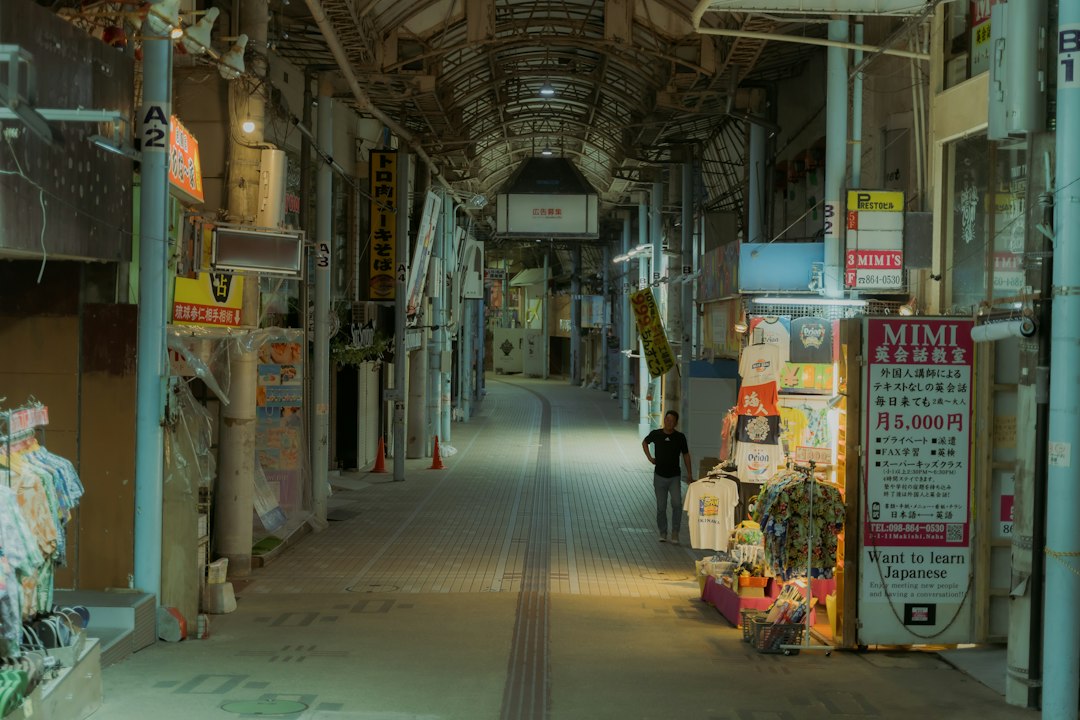
The arcade network behind Kokusai-dori is the only place in Okinawa where you can walk for an hour in a downpour without opening an umbrella. Heiwa-dori, Mutsumibashi-dori and Ichiba Hondori are roofed shopping streets that connect Makishi Station to the Daiichi Makishi Public Market at 2-10-1 Matsuo, about a two-minute walk. Kokusai-dori itself is not covered, so the trick is to duck into the arcades at the first shop entrance and stay in them.
The market runs 8:00 to 22:00, food court last orders at 20:00, and closes on the fourth Sunday of the month (open daily through December), plus New Year and Obon. The system upstairs is the reason to come: buy fish, shellfish or agu pork from a first-floor stall, take it to a second-floor restaurant, pay a per-dish cooking fee, and eat it 20 minutes later.
My opinion on the rest: the souvenir shops along Kokusai-dori sell the same beni-imo tarts and shisa magnets at the same prices, and I’d skip them entirely. The fabric and dry goods shops deeper in Heiwa-dori are far more interesting, and half of them predate the arcade roof.
Which Okinawa museums are actually worth the entry fee on a wet day?
The Okinawa Prefectural Museum and Art Museum in Omoromachi, Naha, is the best value indoor hour on the island: ¥530 for the museum’s permanent exhibition and ¥400 for the art museum collection exhibition, with special exhibitions priced separately (a recent one was listed at ¥1,400 general). Hours are 9:00 to 18:00 Tuesday, Wednesday, Thursday and Sunday, and 9:00 to 20:00 on Friday and Saturday, last admission 30 minutes before closing, closed Mondays. It’s about a 10-minute walk from Omoromachi Station on the Yui Rail, and most exhibit cards are in English and Japanese. Two hours covers the permanent galleries at a slow pace.
In the south, the Okinawa Prefectural Peace Memorial Museum in Itoman (adult admission ¥300, 9:00 to 17:00, last entry 16:30) and the Himeyuri Peace Museum (listed at ¥450, 9:00 to 17:25) sit about 10 minutes apart by car. Both are heavy, and both are better in bad weather than in blazing sun.
Affiliate link: if you book through this, I may earn a small commission at no extra cost to you.
If you’d rather be underground than in a gallery, Okinawa World and Gyokusendo Cave in Nanjo works in rain: the cave runs roughly 5 km, with about 890 m open to visitors on a paved walkway. It’s already wet down there, so nothing changes.
How much longer do Okinawa drives take in heavy rain, and which routes flood?
Budget 20 to 30 percent more time for any drive in steady rain, and more if you’re crossing Naha between 7:30 and 9:00 or 17:00 and 19:00. Naha to the Churaumi area in Motobu is about 95 km and roughly two hours in good conditions via the Okinawa Expressway; in heavy rain, two and a half is realistic.
Here’s the part people get wrong: the expressway ends at Kyoda IC. The final 30 to 40 minutes to Motobu runs on Routes 449 and 505 no matter what you paid in tolls, and that stretch is where wet-weather delays actually happen. The toll from Naha IC to Kyoda IC for a regular car is around ¥1,020, and on a rainy weekday it’s still worth paying, because the free alternative, Route 58 through Onna, collects standing water and crawls behind buses.
Affiliate link: if you book through this, I may earn a small commission at no extra cost to you.
Low-lying junctions in central Naha and the underpasses around Kokusai-dori pond quickly in the sort of downpour that drops 50 mm in an hour, which Okinawa gets several times each June. If you’re picking up a rental car in Okinawa, add 40 minutes: most companies shuttle you from the airport to an off-site depot, and those shuttle queues get longer when it rains.
Which outdoor bookings are refundable when the weather turns, and which aren’t?
The rule that catches most visitors: rain almost never cancels a marine tour, but wind does. Operators run snorkel and dive trips in light rain because you’re already wet; what stops a boat is swell and wind, which often arrive on days that look fine from your hotel window. So a drizzle-out day may still leave you legally on the hook for a booking you no longer want.
| Booking type | Typical cancellation window | What actually cancels it |
| Kerama Islands ferry (Tokashiki, Zamami) | Refunded when the operator cancels; no-shows are not | Swell and wind warnings, not rain |
| Boat snorkel or dive tour | Most platform listings show free cancellation up to 24 hours before | Wind, swell, small-craft advisories |
| Kayak or SUP, mangrove or coastal | Free cancellation up to 24 hours before on most listings | Thunder and lightning, wind |
| Glass or pottery workshop | Studio policy, often 1 to 3 days ahead | Almost nothing; these run in any weather |
| Dated attraction tickets (aquarium, theme parks) | Varies by platform; open-dated tickets are the safe buy | Typhoon closures only |
Two practical habits. First, book marine activities for the first half of your trip so you keep a spare day to reschedule. Second, choose open-dated attraction tickets over date-locked ones whenever the price gap is under a few hundred yen, because that flexibility is what lets you flip a rained-out morning into an indoor one without paying twice.
What’s Easy to Get Wrong Here
The most common mistake is treating a rainy morning as a reason to drive further. Visitors who planned a Kerama beach day often respond to rain by heading 95 km north to Churaumi, which puts them on the road exactly when every other visitor has the same idea and the weather is worst.
The second mistake is assuming everything indoors stays open. The Okinawa Prefectural Museum and Art Museum publishes a typhoon rule: it closes roughly two hours before Naha city buses stop running, and reopens about two hours after they resume, with no opening at all if fewer than three usable hours remain in the day. Churaumi also warns of unscheduled closures in typhoon conditions.
Third: many craft workshops need reservations that same-day walk-ins can’t cover, and several Yomitan studios close midweek. Fourth: distillery tastings and rental cars don’t mix, and there is no forgiving grey zone in Japanese drink-driving law.
Daisuke’s call: On a wet day, drive less and book earlier, because distance costs you more in Okinawa rain than any admission fee does.
What I’d Do Differently When Planning a Rain Day
If I were rebuilding a washed-out itinerary from scratch, I’d stop treating the aquarium as the default and start treating it as the expensive fallback. At ¥2,180 for adults plus roughly four hours of driving from Naha and back, Churaumi costs you most of a day. A ¥530 museum ticket in Omoromachi plus a free distillery tour in Shuri plus an arcade dinner costs less than one aquarium ticket and never takes you out of walking range of a monorail station.
I’d also stop buying date-locked tickets in advance for anything outdoors. Flexibility is worth more than a 15 percent discount in a climate where Naha averages around 228 mm of rain in June across roughly 20 rainy days.
And honestly, I think the glass-blowing sessions are oversold as an activity. The actual blowing takes under a minute of your own effort, with craftsmen doing the difficult parts. Go for the finished object and the workshop floor, not for the illusion that you made it yourself. Pottery hand-building gives you far more time with your hands in the material for a similar price.
For dry-weather backups once the sky clears, my list of 30 local picks across Okinawa is organised by region so you can swap plans without re-planning the driving.
Frequently Asked Questions
Does it rain all day in Okinawa, or does it clear up?
Most Okinawan rain outside typhoons arrives in bands rather than as constant drizzle, so a wet morning frequently breaks into sun by mid-afternoon. Naha averages around 228 mm across roughly 20 rainy days in June, its wettest month, but very few of those days are total washouts. Plan indoor stops for the morning and keep a beach or viewpoint as a flexible late-afternoon option.
Is Churaumi Aquarium busier when it rains?
Yes, noticeably. It’s the most publicised indoor attraction in the prefecture, so rain concentrates visitors between about 10:00 and 14:00, especially on weekends and Japanese holiday periods. Standard closing is 18:30 with last admission at 17:30, so arriving after 15:00 gives you a calmer visit at the same ¥2,180 adult price.
Can I do a rainy day in Okinawa without renting a car?
Comfortably, if you stay in Naha. The Yui Rail monorail reaches Shuri for Zuisen Distillery, Makishi for the covered market and arcades, and Omoromachi for the prefectural museum, all within a 10 to 15 minute walk of each station. Add bus 89 from Akamine for Chuko Distillery in Tomigusuku, about ¥280.
Will my boat tour be cancelled because of rain?
Usually not. Operators run in rain and cancel for wind, swell and lightning, so check the marine forecast rather than the rain forecast. Most listings on the major booking platforms allow free cancellation up to 24 hours before the start time, which means a same-morning decision by you is generally not refundable.
About the author
I’m Daisuke. I write okinawa-insider.com, an English-language travel site about this island, and I’ve been born and raised in Okinawa (34 years and counting). I write about the practical stuff that decides whether a trip works: hours, fares, drive times, and which things are honestly worth the money. Prices and opening times in this article come from official sites and posted listings and were checked in September 2026; always confirm before you travel, since typhoon season rewrites schedules with no notice.
Plan Your Okinawa Trip
These are affiliate links. If you book through them, I may earn a commission at no extra cost to you.
- Churaumi Aquarium tickets — skip the ticket window at northern Okinawa’s aquarium, which matters most on wet weekends.
- Okinawa World & Gyokusendo Cave — the cave walkway runs about 890 m and is unaffected by rain.
- Okinawa car rental — essential for Itoman, Yomitan and anything north of Nago.
Prices and availability change; confirm on the booking page before you pay. Nothing here is a paid placement, and I only link to operators I’d point a friend toward.
Read Next: Spoke Guides
- Travelling Okinawa in the rainy season — when the rain bands actually arrive and how to plan around them.
- 30 local picks across Okinawa — region-by-region, so you can swap plans without redoing your driving.
- Awamori, Okinawa’s rice spirit — what to taste at a distillery and what to bring home.
Update Log
- 2026-09-14: First published.