In 2026 you can walk right up to a finished-looking vermilion Seiden at Shuri Castle, but you can’t go inside it until 23 November 2026, and the up-close craftsman-viewing phase is already over. I’m Daisuke, born and raised in Okinawa (34 years and counting), and I run this site because most English pages about Shuri Castle are still describing a 2023 construction site that no longer exists. This piece sorts out what’s actually standing, what’s free, what costs money, what the price change means, and whether the hill is worth your morning.
This post contains affiliate links. If you book a tour or buy through them, I may earn a commission at no extra cost to you.
What can you actually see at Shuri Castle in 2026?
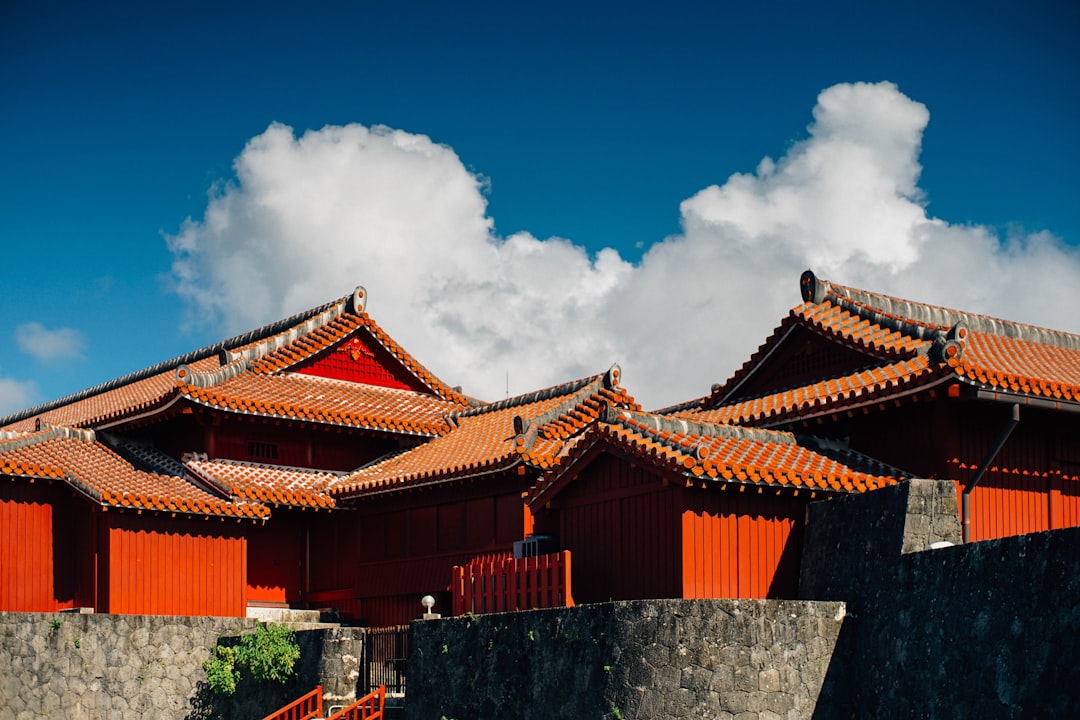
You see a completed exterior and a closed interior. The huge temporary shed (suyane) that covered the main hall was fully dismantled by the end of October 2025, so the Seiden’s red exterior has been standing in the open for the first time in about six years, while direct access to the Seiden itself stays closed until completion in autumn 2026. So the money shot from the Una courtyard is back. The scaffolding walkway where you could watch carpenters and lacquer workers at arm’s length is gone with it.
What’s left inside the paid zone is still substantial:
- The Una courtyard with its striped paving, facing the rebuilt Seiden.
- Life-sized onigawara roof ornaments displayed in the rear courtyard (Kushi-nu-una), roughly 1.5 m wide and 0.9 m tall, the same pair installed on the Seiden roof — genuinely odd to see at eye level.
- A reconstruction exhibition room with panels, prototype decorations and before-and-after photos, plus Yohokoriden with a large screen on the Ryukyu Kingdom and the rebuild.
If you arrive expecting live carpentry, you’ll be disappointed. The interior lacquering and fittings work happening in 2026 is behind closed doors.
When does the Seiden reopen, and do you need to book a slot?
The Seiden opens to the public on Monday 23 November 2026, and yes, going inside requires a timed reservation. The park has confirmed a completion ceremony on Sunday 22 November 2026, with public use of the Seiden starting on 23 November, a national holiday. Interior viewing is capped and runs on advance reservations with 30-minute time slots; the rest of the paid area still works without any booking.
The sales calendar matters if you’re travelling this winter. Tickets for entry between 23 November and 31 December 2026 go on sale in two rounds: 1 September 2026 at 13:00 and 1 October 2026 at 13:00. From January 2027 entry onward, sales open at 13:00 on the 1st of the month two months ahead. Same-day window purchase is possible if slots remain, but I wouldn’t plan around that for the opening fortnight.
Groups have it harder. Group Seiden viewing is by lottery through a group form, and for 23 November to 6 December 2026 no group interior reservations are being accepted at all.
What does Shuri Castle cost in 2026, and what can you see for free?
Right now the paid zone is cheap and it gets more than twice as expensive on 23 November 2026. Current admission is ¥400 for adults, ¥300 for high school students, ¥160 for elementary and junior high students, free under 6. From the Seiden opening it becomes ¥1,000 for adults, ¥760 for high school students and ¥370 for elementary and junior high students, with under-6s still free; the current ¥400 is a reduced rate set while the rebuild is visible. The park attributes the revision to fire-prevention upgrades and higher operating costs, and the paid-area price is the same whether or not you go inside the Seiden.
| Item | Until 22 Nov 2026 | From 23 Nov 2026 |
| Adult admission (paid zone) | ¥400 | ¥1,000 |
| High school student | ¥300 | ¥760 |
| Elementary / junior high | ¥160 | ¥370 |
| Inside the Seiden | Not possible | Yes, 30-min timed slot |
| Reservation needed | No | Only for the Seiden interior |
The free zone is not a consolation prize. Shureimon (the gate on the ¥2,000 note), Kankaimon, the Sonohyan-utaki stone gate, Kyukeimon and the Ryutan pond area all sit outside the ticket gate. On a tight budget you can do a decent 40-minute loop for ¥0.
How do you get to Shuri Castle from Naha Airport or Kokusai-dori?
Take the Yui Rail monorail to Shuri Station, then walk about 15 minutes uphill. Naha Airport to Shuri is ¥360 and roughly 27 minutes, covering 12.9 km. Trains run from around 06:00 to 23:30, every 5–10 minutes in daytime. Shuri Station is a 15–20 minute walk from the castle, and that walk is a real climb in July and August — Naha summer afternoons sit around 32°C with brutal humidity.
From Kokusai-dori, board at Makishi or Kencho-mae and ride to Shuri; it’s under 15 minutes. For several monorail journeys, compare the total single fares with Yui Rail station day passes (official, non-affiliate). A station-issued 1-day pass costs ¥1,000 for adults and ¥500 for children and is valid for 24 hours after purchase. The operator lists qualifying sightseeing discounts; check the current admission and discount conditions for your visit date, especially around the November reopening.
Driving is the weaker option. The Shuriomonkan underground car park charges, from 1 April 2026, ¥500 for the first 60 minutes then ¥250 per 30 minutes for small cars, capped at ¥1,000, with a requested maximum stay of three hours. Add Naha traffic and the monorail usually wins.
Is Shuri Castle worth a half-day on a short Okinawa trip?
Between now and 22 November 2026, budget 90 minutes, not half a day. The Seiden is closed, the Hokuden and Nanden are not rebuilt yet, and once you’ve crossed the Una courtyard, seen the onigawara and read the exhibition panels, you’re done. A half-day only makes sense if you’re also doing Tamaudun, the royal mausoleum a few minutes’ walk from Shureimon, or the Kinjo-cho stone-paved road that drops downhill from the castle’s south side.
From 23 November 2026 the calculation changes. Interior access, a recreated throne area and a ¥1,000 ticket justify a longer, slower visit, and demand will be heavy — the park already draws over 1.3 million visitors a year even mid-construction.
Affiliate link: if you book through this, I may earn a small commission at no extra cost to you.
My honest ranking: if you have three days and want beaches and the aquarium, Shuri is a morning stop, not a headline. If you care at all about how a kingdom governed itself for 450 years, it’s the single most informative place on the island. A guided walk fills the gaps the signage leaves; the Shuri Castle & Peace Memorial walking tour pairs it with the war sites in the south, which is the pairing that actually explains Okinawa. More options in my 30 local picks for things to do in Okinawa.
What did the 2019 fire mean for people who live here?
It wasn’t treated as a lost tourist attraction. The fire broke out on 31 October 2019, was attributed to an electrical cause, and destroyed the three main halls; the main hall and eight other buildings burned. Shuri was the seat of the Ryukyu Kingdom from 1429 to 1879, and the 1992 Seiden was itself a reconstruction of a building flattened in 1945 during the Battle of Okinawa. Losing it a second time in one lifetime landed differently here than a headline about a burned castle suggests.
That’s why the rebuild was framed as a public process rather than a fenced-off site. The project has run under the theme of visible reconstruction, with the public watching the rebuilding as it happened. Craft decisions were deliberate: around 55,000 red roof tiles were produced by traditional workshops in the Yomitan area, and fragments of the dragon ridge ornaments recovered from the fire were 3D-scanned so stone carvers could recreate them by hand in the same limestone.
Is Shuri Castle still a UNESCO World Heritage Site after it burned?
Yes, and this is the point almost every travel article gets muddled. Shuri Castle is inscribed as part of the Gusuku Sites and Related Properties of the Kingdom of Ryukyu, listed in 2000. What’s on the World Heritage list is the castle site itself — the stone foundations, the walls, the ruins beneath the buildings — not the reconstructed wooden halls that burned in 2019. The listing was never in danger, because the inscribed property largely survived the fire underneath the ashes.
That has a practical consequence for what you look at. The stone is the old thing. The oldest surviving structure in the complex is the Sonohyan-utaki stone gate near Kankaimon, built in 1519 and a World Heritage component in its own right, sitting in the free zone where most people walk straight past it. The curving limestone ramparts, which are Ryukyuan rather than Japanese in shape, are also original in large stretches.
So a visit in 2026 is really two visits stacked on one hill: a genuinely old stone site, and a brand-new wooden building on top of it. Knowing which is which changes how you spend your hour.
What’s the best time of day and month to go in 2026?
Arrive at opening, 08:30, on a weekday. Listed hours for the paid area are 08:30–19:00 in April–June and October–November (last entry 18:30), 08:30–20:00 in July–September (last entry 19:30), and 08:30–18:00 from December to March (last entry 17:30), while the free walled areas open from 08:00. Cruise-ship coaches and school groups tend to land mid-morning, so the first hour is the calm one.
Month by month, my view: February and early March are the best combination of thin crowds and comfortable walking weather. Late April through Golden Week gets busy. July and August are punishing on that uphill approach from Shuri Station, though the extended summer hours mean an 18:00 arrival is realistic and much cooler.
Two dates to plan around or avoid. The Shuri Castle Reconstruction Festival runs 1–3 November at Shuri Castle Park and along Kokusai-dori, with a procession of more than 450 participants recreating the royal court. And 23 November 2026, the Seiden opening, will be the most crowded day the site has seen in years. Festival dates for the rest of the year are in my 2026 Okinawa festivals calendar.
What’s Easy to Get Wrong Here
Most mistakes at Shuri come from outdated information rather than bad planning. Here are the ones that cost people time or money in 2026:
- Assuming you can watch craftsmen at work. The shed over the Seiden was dismantled by late October 2025, and the observation walkway went with it. Guides written in 2023 and 2024 still promise it.
- Assuming the whole complex reopens on 23 November 2026. The Hokuden and Nanden are scheduled for reconstruction after the Seiden opens, so the full inner courtyard set won’t be finished for years.
- Turning up on the opening weekend without a slot. Interior viewing is reservation-only in 30-minute slots.
- Paying full price with a monorail pass in your pocket. The pass gets 20% off admission.
- Budgeting three hours. Before the Seiden opens, that’s roughly double what the site currently supports.
Daisuke’s call: Go before 22 November 2026 for ¥400 and a quiet courtyard, or book a slot and go in December — the in-between is the worst of both.
What would I do differently when planning a Shuri Castle visit?
I’d stop treating Shuri as a standalone destination and start treating it as the first stop of a Naha history morning. The castle alone runs 90 minutes in its current state; the surrounding Shuri district easily fills the rest.
Three changes I’d make to the standard itinerary:
- Walk down, not back up. Leave via the Kinjo-cho stone-paved road on the south side instead of retracing your steps to Shuri Station. It’s a 16th-century paved lane through a residential area, downhill, and free.
- Add Tamaudun. The royal mausoleum is a short walk from Shureimon, listed at ¥300 for adults, and it’s the quietest World Heritage component in Naha. Ten minutes there does more for understanding the kingdom than another loop of the courtyard.
- Check your transport pass before you travel. See Yui Rail station day passes (official, non-affiliate) for prices and qualifying sightseeing discounts. Buy a station-issued pass just before boarding, because its validity starts at purchase. Check Shurijo Castle Park’s current admission and discount conditions separately.
If you’re on a cruise call with a fixed window, don’t improvise this — my Naha cruise port day plan has the timings that actually fit a ship’s schedule.
What’s worth pairing with Shuri Castle in the same morning?
The best pairing depends on whether you want more Ryukyu Kingdom or more 20th-century Okinawa. Both are half-hour rides from Shuri and they tell very different stories.
For more kingdom: Shikinaen, the royal family’s secondary residence with a Chinese-style garden, sits about 3 km south of the castle and is another Gusuku Sites component. It’s calm, green, and almost never crowded — easily my preferred hour in Shuri on a hot day.
Affiliate link: if you book through this, I may earn a small commission at no extra cost to you.
For context that hits harder: the southern war sites. Himeyuri and the Peace Memorial Park explain why the 1945 Seiden had to be rebuilt in the first place, and seeing them the same day as the castle makes both land properly. The Shuri Castle & Peace Memorial walking tour handles that combination with a guide, which I’d take over doing it alone by bus.
What I would skip: stacking Kokusai-dori onto the same morning. The shopping street’s western end sits by Naha Bus Terminal at Asahibashi and it’s fine for an evening, but shoving it between the castle and lunch just means a rushed, sweaty hour in a souvenir arcade. Do it after dinner instead.
Frequently Asked Questions
Can I go inside the Shuri Castle Seiden right now in 2026?
No. Public access to the Seiden interior begins on 23 November 2026 and requires an advance reservation for a 30-minute time slot. Until then you can see the completed exterior from the Una courtyard but not enter the building.
How much is Shuri Castle admission in 2026?
Adults currently pay ¥400, high school students ¥300, elementary and junior high students ¥160, and under-6s are free. From 23 November 2026 those rates rise to ¥1,000, ¥760 and ¥370. The free zone with Shureimon and the Sonohyan-utaki stone gate stays free either way.
How long does a visit to Shuri Castle take?
About 90 minutes before the Seiden opens, including the walk from Shuri Station. After 23 November 2026, allow two to two and a half hours if you have an interior slot, since timed entry means waiting for your window.
Is Shuri Castle wheelchair accessible during reconstruction?
Partly. The park has lift and slope routes through the main visitor areas, but the historic ramparts, gates and the Kinjo-cho stone road involve steps and steep gradients. Check the park’s current accessibility route map before going, since restoration work shifts which paths are open.
About the author
I’m Daisuke. I’m born and raised in Okinawa (34 years and counting), and I write okinawa-insider.com in English because the guides my visiting friends read were consistently a year or two out of date. I check official park notices, timetables and posted prices before I publish, and I say plainly when something isn’t worth your time.
Plan Your Okinawa Trip
These are affiliate links. If you book through them I may earn a small commission at no extra cost to you.
- Shuri Castle & Peace Memorial walking tour — guided history walk linking the castle with the southern war sites.
- Yui Rail station day passes (official, non-affiliate) — unlimited monorail rides for 24 hours after purchase; check the operator’s current attraction-discount conditions.
- Same walking tour, for short cruise-call or layover days — the one booking I’d make if I only had one Naha morning.
Prices and schedules change. Confirm admission, opening hours and Seiden reservation availability on the official Shurijo Castle Park site before you travel.
Read Next: Spoke Guides
- Things to do in Okinawa: 30 local picks
- Okinawa festivals calendar 2026
- Naha cruise port day plan
Update Log
- 2026-08-27: First published.