By Daisuke — born and raised in Okinawa (34 years and counting).
For a Naha city hotel, take the Yui Rail monorail — ¥290-¥360 for stops from Kencho-mae to Shuri (checked October 2026) and roughly 13 minutes from Naha Airport Station to Kencho-mae. For an Onna resort, take the airport limousine bus (1.5-2 hours). For families with luggage or late flights, book a private transfer. I’m Daisuke, born and raised in Okinawa (34 years and counting), and I write okinawa-insider.com. As a lifelong local, I recommend matching transport to your hotel zone — not the cheapest fare — because the wrong choice strands you at the airport after 23:30.
This post contains affiliate links. If you book a tour or buy through them, I may earn a commission at no extra cost to you.
Which way from Naha Airport to my hotel is actually best?
It depends entirely on where you’re sleeping, not on which option sounds fanciest. If your hotel is in central Naha (Kokusai-dori, Asahibashi, Omoromachi), the monorail wins on price and predictability. If you’re headed to an Onna Village resort like Renaissance or Nikko Alivila, the airport limousine bus is the sane default. Taxis and rideshare make sense for short hops or groups doing the math. Private transfers are for families, late arrivals, or anyone who refuses to wrangle suitcases on a bus.
Here’s the reasoning most blogs skip: distance from the airport drives the decision. Travel times from Naha Airport run about 20-30 minutes to the Senaga Island / Toyosaki area, around 1 hour to Mihama in Chatan, 1.5 to 2 hours to Onna Village, and 2 to 2.5 hours to the Churaumi Aquarium area. For US military families, here’s the number no other blog gives you: from Naha Airport it’s roughly 45-55 minutes to Kadena AB Gate 1 and about 40-50 minutes to Camp Foster’s Legion Gate in normal daytime traffic — but the Route 58 crawl through Naha after 16:00 can add 25 minutes, which I learned the hard way picking up a friend in October 2025.
One more framing point: think about how many people are traveling and how much luggage you have, not just the sticker price. A solo traveler with a carry-on has completely different math from a family of four with three checked suitcases and a stroller. The monorail rewards light packers; the bus and private car reward groups.
| Option | Takes US credit cards? | English staff/signage? |
|---|---|---|
| Yui Rail monorail | Yes — contactless Visa/Mastercard tap | Signage yes; ticket machines have English |
| Limousine bus | No — cash-only at counter (some IC card) | Counter staff limited English; route sheet in English |
| Taxi / GO / Uber | Yes — most accept cards + IC | App removes language friction; drivers minimal English |
| Private transfer | Yes — prepaid online in USD | Booking in English; driver holds name sign |
For help picking the zone itself, see my Naha vs Onna guide, and if you’re deciding whether Okinawa even beats the mainland for this trip, my Okinawa vs other Japan destinations comparison covers the stroller-and-transit reality honestly.
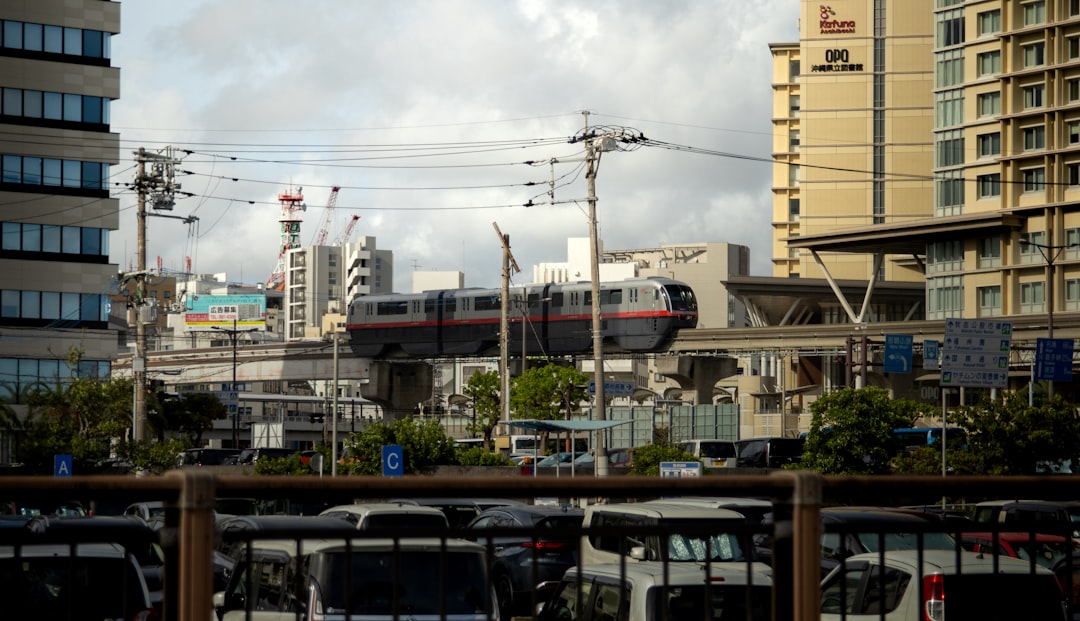
How do I get from Naha Airport to a Naha city hotel?
Take the Yui Rail monorail — the fastest, cheapest, most predictable option for any hotel in central Naha. Naha Airport Station connects directly to the terminal via a covered walkway, so you roll your bags straight from arrivals to the platform without stepping outside. It takes about 13 minutes to Kencho-mae Station and about 19 minutes to Omoromachi Station.
Single fares are low: ¥290-¥360 for stops from Kencho-mae to Shuri (checked October 2026), with contactless payment accepted. If you’ll ride several times in one day, the Yui Rail 1-day pass gives unlimited rides. Per Okinawa Urban Monorail’s official fare table, the 1-Day Pass is ¥1,000 adults / ¥500 children and the 2-Day Pass is ¥1,800 / ¥900, valid 24 or 48 hours after purchase at a station; buy just before boarding (checked October 2026). Honestly, for airport-to-hotel-and-back, skip the pass and tap your card.
How often do the trains run, and where do I stand with luggage?
Trains run roughly every 8 to 15 minutes, tightest during morning and evening peaks and slightly longer after about 21:00. The airport is the southern terminus, so every departure runs north toward the city and Shuri — you can’t board the wrong direction. Each two-car train is compact.
Which station is closest to my hotel on Kokusai-dori?
- Kencho-mae — western (Palette Kumoji) end of Kokusai-dori
- Makishi — eastern (Asato) end
- Miebashi — middle, near the covered Heiwa-dori arcade
- Shuri — for Shuri Castle Park
- Omoromachi — T Galleria and the Prefectural Museum
Check your hotel’s exact address so you don’t walk the full 1.6 km strip with bags. If you’re timing your visit for the pink season, note that Shuri Station sits near two of the spots in my cherry blossom photography guide — worth a morning detour in late January.
What if I’m carrying US dollars only on arrival?
The monorail solves this for you — a US contactless Visa or Mastercard taps straight through the gate, no yen needed for night one. I’ve watched US families land with only dollars and panic at the bus counter; on the monorail, that’s a non-issue. Grab yen from the 7-Eleven ATM in the arrivals hall (accepts US cards) only once you’re at your hotel and unhurried.
How do I get from Naha Airport to Onna without a car?
Take the airport limousine bus — a direct, luggage-friendly ride to the Onna resort strip that beats every other public option for that distance. Onna Village sits about 1.5 to 2 hours from Naha Airport by road. Staff load your suitcases into the underfloor hold rather than making you balance them in the aisle.
Fares run roughly ¥1,600-¥2,800 (about $11-$19 USD as of January 2026) for Onna, Nago, and Yomitan, depending on how far up the coast your hotel sits. Buy tickets at the Limousine Bus counter in the Arrivals Hall on 1F.
Departures are timed to the route rather than running every few minutes, so check the posted schedule and give yourself a buffer after collecting bags; missing one can mean a 45-minute-plus wait.
Which resorts are actual bus stops?
Onna-area stops include Renaissance Resort, Best Western Okinawa Onna Beach, Royal Zanpamisaki, and Nikko Alivila; the route also serves Chatan-area stops such as the hotel near American Village. If your resort isn’t a listed stop, check the nearest one and the walk before you commit.
Weighing the bus against a rental car
The bus removes the airport rental-office wait entirely — the same 60-90 minute trap I flagged above. For SOFA-status families, one Y-plate reality worth knowing: some off-base beach and restaurant lots in Onna and Chatan post no Y-plate signs or watch them closely during summer weekends — the bus sidesteps that on arrival day. If you’d rather have a car the whole trip, weigh the daily rate against the hassle honestly before you land.
Booking your resort itself first? ↓ Search Onna Village resorts on Agoda
Onna resort rates rise in July-August and Golden Week, so compare a few dates before you book. If you’re staying in central Naha for a short city trip, also check booking a business hotel direct.
Is a taxi or rideshare from Naha Airport worth it?
A taxi is worth it for short trips into Naha or when you’re a group of three or four splitting the fare — but it’s poor value for northern resorts. A taxi to Kokusai-dori runs about ¥2,000-¥2,500 (about $13-$17 USD as of January 2026), while a taxi to northern resorts like Busena or Halekulani can exceed ¥15,000, where the bus is far better value.
The taxi rank sits on the ground floor (1F) directly outside the arrivals exit, staffed, so you rarely wait long during daytime hours. Standard Okinawa meters start in the low ¥600 range and tick up per short distance. Almost all taxis now accept IC cards and major US credit cards — but confirm with the driver before you set off, especially for a long metered ride. I once got into an older independent cab at OKA in 2024 whose reader was “broken”; now I always ask “kaado, OK?” through the window first.
Do GO and Uber work at Naha Airport?
Yes, with a caveat. In 2026, both GO and Uber are integrated with local taxi fleets, so you book from the app for transparent pricing. In practice these apps dispatch regular taxis rather than private drivers, so don’t expect fares to undercut the meter much. The upside is a fixed quote and no language friction at the rank — useful if you’re solo and tired.
Should families with luggage book a private transfer?
Yes — for families, three or more suitcases, or car-seat needs, a private transfer is usually the least stressful option and often competitive with a long taxi ride. A private car takes you door to door with no counter queues, no cash-only ticket scramble, and no dragging bags between stops.
The value case is strongest for Onna and north. Remember the taxi math: a metered northern run can pass ¥15,000, so a pre-booked flat rate removes the meter anxiety on a 90-minute-plus drive. For a Naha city hotel, a private transfer is overkill unless you genuinely can’t manage the monorail with small kids and luggage at once.
The real reason I recommend it to families isn’t speed, it’s the arrival. After a long flight with tired kids, a named driver holding a sign beats decoding a bus timetable. If your flight lands after the monorail’s evening cutoff, a transfer stops being a luxury and becomes the only clean option.
Affiliate link: if you book through this, I may earn a small commission at no extra cost to you.
↓ Check availability — Naha Airport private transfer (up to 4)
I booked a private transfer in December 2024 for a friend’s family of four arriving at 22:10 — flat ¥13,500-equivalent to a Chatan hotel, prepaid in USD, driver waiting with a sign. Honest drawback: if your flight is badly delayed past the driver’s window, rebooking isn’t instant — confirm the operator’s delay policy at checkout. Skip this if you… are a solo traveler or couple heading to central Naha, where the monorail is a fraction of the price and just as fast.
What happens if my flight lands late at Naha Airport?
If you land late, the monorail may already be closed, so plan a taxi or pre-booked transfer before you fly. The Yui Rail operates 6:00-23:30 (as of January 2026), which means a delayed evening flight can easily miss the last train. Buses to the resorts also thin out after dark, and the limousine counter isn’t a 24-hour operation.
The real trap isn’t the hour — it’s the airport process. OKA is notorious for the rental-car wait: even with a confirmed reservation, the shuttle to the off-site office plus paperwork can consume 60-90 minutes. A 22:00 landing plus baggage plus a rental shuttle can push you past every public transport cutoff. If you’re renting anyway, consider picking up the car the next morning instead of arrival night.
As a concrete cutoff: the last northbound Yui Rail from Naha Airport Station leaves around 23:30, so if your baggage belt is still moving at 23:15, walk toward the taxi rank, not the platform.
How do the four options compare by hotel area and price?
The quick answer: match your transport to your hotel’s zone. Naha hotels favor the monorail; Chatan and Onna favor the bus or a transfer; anything north of Nago is transfer or taxi territory only if budget allows.
| Hotel area | Distance/time from OKA | Best option | Indicative cost (USD approx, Jan 2026) |
|---|---|---|---|
| Central Naha (Kokusai-dori, Omoromachi) | ~13-19 min by rail | Yui Rail monorail | ¥290-¥320 one way (checked October 2026) |
| Chatan / Mihama (American Village) | ~1 hour | Limousine bus or transfer | Bus ~¥1,600+ (~$11) |
| Onna Village resorts | ~1.5-2 hours | Bus or private transfer | Bus ~¥1,600-¥2,800 (~$11-$19) |
| Nago / northern resorts | ~2 hours+ | Private transfer (taxi if budget allows) | Taxi can exceed ¥15,000 (~$100) |
| Kadena AB / Camp Foster area | ~40-55 min | Transfer or taxi (rental next-day) | Taxi ~¥6,000-¥8,000 (~$40-$54) |
Two honest notes. First, group size flips the math in Naha: four people in one taxi at ~¥2,000-¥2,500 can undercut four monorail fares plus the luggage hassle. Second, for a single traveler going past Chatan, the bus is almost always the value pick unless you land after the last departure.
A third note on timing: fares above are one-way, so double them for the return leg. If you have an early departure flight, the Yui Rail’s first train from the city runs from around 6:00 — fine for most flights but tight if you must check in before 6:30, in which case pre-book a taxi the night before. For inbound flight planning, my getting to Okinawa flights and ferries guide covers realistic arrival windows.
What can I do near the airport if I arrive too early to check in?
The Senaga Island / Ashibina area is 20-30 minutes out and easy with bags in a taxi. For a fuller day-one plan, my 7 days like a local itinerary flags spots that don’t require a hotel drop-off first, and if you’d rather spend day one on the water, my 7 reefs I mapped from 2024-2025 tells you which shore is actually swimmable straight off the plane.
What’s easy to get wrong here?
The most common mistake is picking transport by cost alone instead of by hotel zone and arrival time. People book a cheap monorail plan for an Onna resort two hours away, then scramble at the airport. Others assume a taxi north is fine, then watch the meter pass ¥15,000.
- The limousine bus does not accept cash on board — buy a ticket at the 1F counter in advance.
- Not every resort is a short transfer from the airport — check your hotel’s actual location before you choose a transport method, because northern and Onna-area properties are a very different trip from a Naha city hotel.
Plan Your Okinawa Trip
Affiliate links — using them helps support this site at no extra cost to you.
- Naha Airport private transfer — private car to/from your hotel (up to 4 passengers)
- Naha Airport private transfers on Viator — private transfers for families and late arrivals
- Yui Rail station day passes (official, non-affiliate) — station-issued 1-day tickets cover unlimited monorail rides for 24 hours after purchase. Buy just before boarding.
- Okinawa car rental — essential for the islands and northern routes
Affiliate link: if you book through this, I may earn a small commission at no extra cost to you.
Affiliate link: if you book through this, I may earn a small commission at no extra cost to you.
Affiliate link: if you book through this, I may earn a small commission at no extra cost to you.
Small commissions from these partners help keep this guide independent.