When relatives fly in to see you in Okinawa, the most useful off-base plan is usually slower and more local than a list of famous attractions suggests. This guide is for military families hosting ordinary visiting relatives. It covers easy weekend ideas, the etiquette that helps, 3-day and 5-day plans with weather backups, how the Kerama boats connect, and what visiting drivers need. It does not cover PCS, SOFA status or base access. Your sponsor and official command and installation channels are the right sources for those.
Affiliate disclosure: this article contains affiliate links, and I may earn a commission if you book through them, at no extra cost to you.
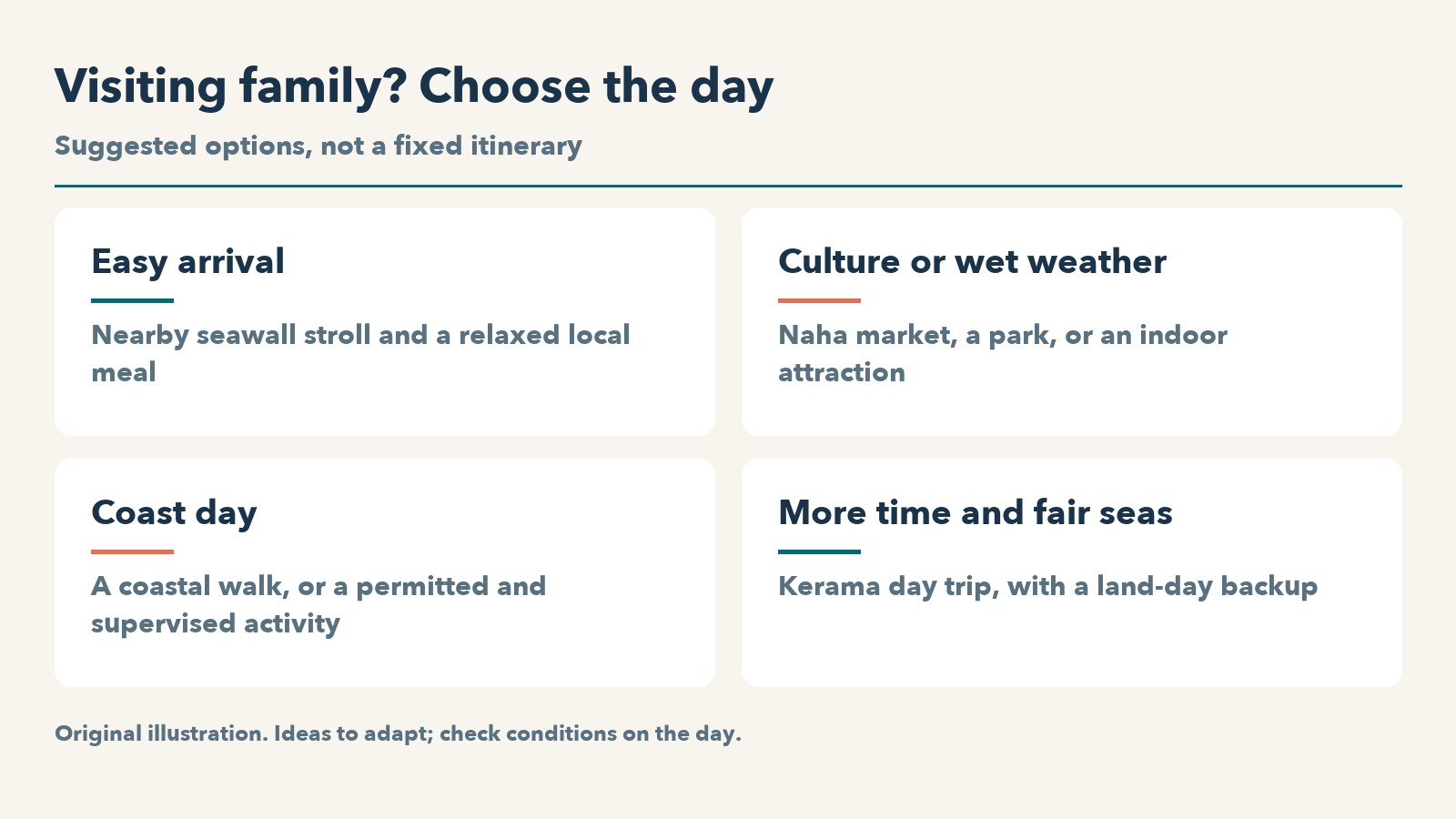
Where can you spend an easy off-base weekend in Okinawa?
A good off-base weekend here rarely needs a ticket. A morning at a beach park or seawall, an air-conditioned mall when it is hot or wet, and an early dinner somewhere with easy parking cover a lot of ground.
Here are some concrete starting points. Yachimun no Sato in Yomitan is a working pottery area you can stroll around. Workshops and shops keep their own hours, so check before you go. Zakimi Castle ruins, also in Yomitan, is one of the gusuku sites on the UNESCO World Heritage list, and a walk around the walls takes about half an hour. Cape Zanpa, on the Yomitan coast, has a lighthouse and cliff views that make a good short stop.
If you will be living here a while, I have one proposal. Before family arrives, get to know one supermarket, one shokudo, one beach beyond the nearest, and one michi-no-eki roadside station, such as Michi-no-Eki Kyoda near the northern end of the expressway. That gives you a short list of your own to share. For more ideas organised by area, see 30 local picks across Okinawa.
Which famous stops are better saved for visiting relatives?
Three of the most repeated recommendations can work well as outings with visitors rather than as a regular weekend plan. Kokusai-dori, Naha’s best-known shopping street, suits a one-evening stroll. If you are buying souvenirs, it is worth comparing with a michi-no-eki or supermarket. American Village in Chatan is a shopping and entertainment complex, and it fits nicely as the last stop of a day out with guests. Churaumi Aquarium takes a full day from central or southern Okinawa, so it sits inside the visitor plans below.
What etiquette helps off base in Okinawa?
Four everyday areas are worth a quick briefing before relatives arrive.
- Parking: many lots are reserved for one business’s customers. Park only where signs allow, and follow the payment instructions at coin lots. Don’t leave the car in a shop’s lot while you walk somewhere else.
- Noise: if relatives stay in off-base housing or a rental, keep late-evening outdoor noise down. Check any building or rental rules on quiet hours.
- Beaches: managed beaches set their own swim season, swim areas and lifeguard hours. Swim only where and when swimming is permitted and supervised, stay inside any netted area, and follow posted restrictions. Nets at some beaches help keep out habu-kurage box jellyfish, a real warm-month hazard. Outside supervised times, enjoy the sand and save swimming for a supervised day.
- Onsen and sento: wash thoroughly at the shower stations before you get in. Swimwear is not worn, and towels stay out of the bath. Tattoo policies differ by facility, so check ahead if that matters to your group.
How do you order at a restaurant without an English menu?
A few phrases and a phone go a long way at a shokudo, a casual local diner. Say sumimasen to get attention, then point and say kore o kudasai (“this one, please”). A camera translation app such as Google Lens helps with menu words. Okinawa soba, goya champuru, taco rice, agu pork and umi-budo (sea grapes) cover a good share of local menus.
Some practical points:
- If there is a ticket machine by the door, you usually buy your ticket before sitting down.
- Tipping is not customary in Japan.
- Some smaller shops don’t take cards, so carry some cash.
- Some shops close between lunch and dinner, so check posted hours before driving out mid-afternoon.
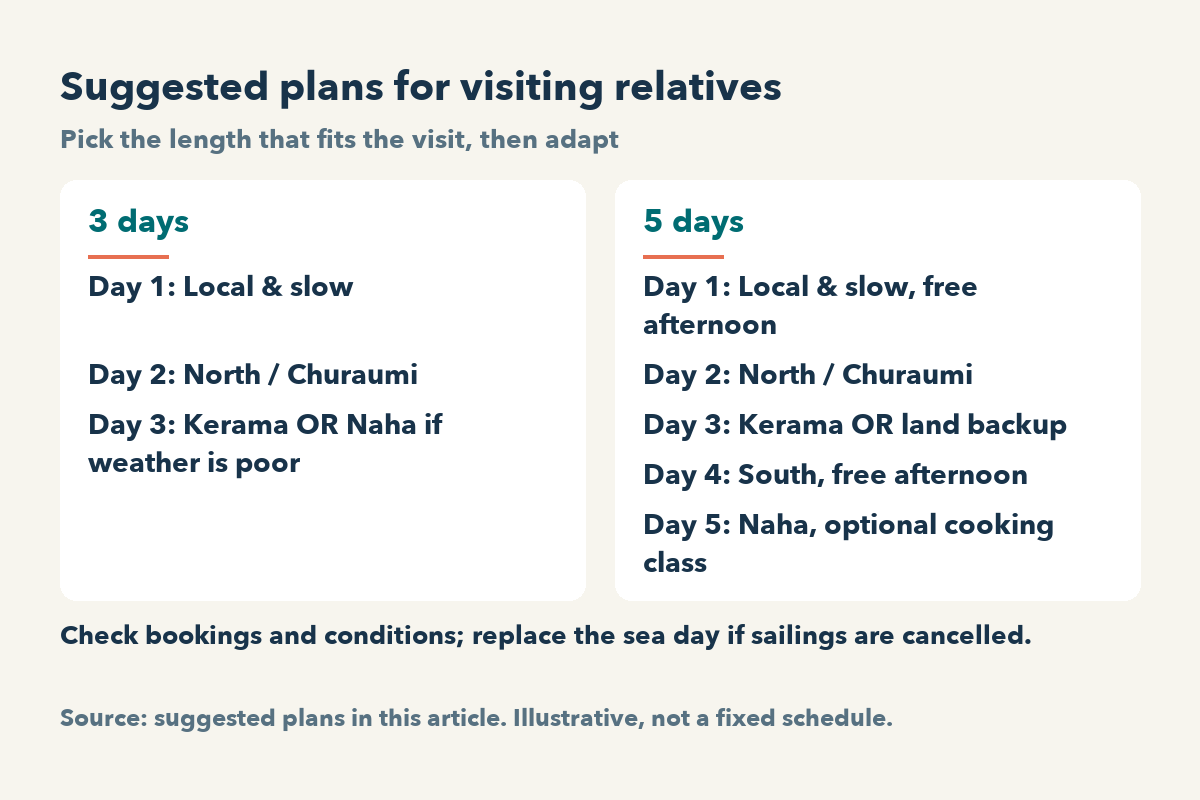
What’s a sensible 3-day plan for relatives after a long-haul flight?
The pattern I’d propose is one low-effort day, one big day, and one flexible day that can be either a boat trip or a land day. People handle long flights and time differences very differently, so keep the first day short and leave room to change the order. Treat this as a starting point, not a guaranteed schedule.
Day 1: stay close. Take a seawall or beach-park walk near where your relatives are sleeping. Add a supermarket visit, which is an underrated window into everyday food, and an early dinner. Book nothing you would lose money cancelling.
Day 2: the north. Okinawa Churaumi Aquarium in Motobu is often around two hours’ drive each way from Naha, depending on traffic. The official admission page lists these prices (checked 7 October 2026, and again on 25 October 2026 on the aquarium’s official web-ticket page): ¥2,180 for adults, ¥1,440 for high school students and ¥710 for elementary and junior high students, with under-6s free. Since July 2026, Ocean Expo Park has been trialling a partial opening on Wednesdays: the aquarium stays open, but some facilities, including the Tropical Dream Center and Café Squall, close. If nobody wants four hours behind the wheel, a packaged day tour is an alternative. Affiliate disclosure: the following is an affiliate link, and I may earn a commission if you book through it, at no extra cost to you. 1-day tour: Churaumi Aquarium, Cape Manzamo and American Village. Its published itinerary covers those three stops plus the Bise Fukugi tree-lined road and the Tropical Dream Center, over about 11 hours. According to the listing:
- Commentary is a multilingual audio guide that includes English. You need your own smartphone and earphones to use it.
- The tour is not accompanied by a tour guide; a tour conductor shows participants to the entrance of each stop.
- Boarding stops include Naha and Chatan.
The listing’s meal details conflict. Its description mentions an Okinawa soba lunch at a café inside the park, but its “Includes” section marks meals and drinks as not included. Don’t count on lunch until you have confirmed it, along with the price and date, for your chosen option when booking.
Day 3: Kerama by boat, or a land day. If the forecast and timetable look workable, take a boat from Tomari Port to Tokashiki or Zamami (details below). If sailings are cancelled or the forecast is marginal, switch to a Naha day with Shurijo Castle Park and the Makishi market area. The park’s opening and admission announcement and the closure notice on the Shurijo Castle Park website give these details:
- The reconstructed main hall opens to general visitors at noon on 23 November 2026.
- The whole park is closed all day on 22 November for the completion ceremony. On 23 November, the free area inside the castle walls opens at 11:15 and the paid area at noon. The park expects crowds that day and says entry details will follow.
- Going inside the main hall needs an admission ticket with a date-and-time reservation in 30-minute slots. The time slot costs nothing extra.
- You can still enter the rest of the paid area without a reservation if you don’t go inside the main hall.
- From 23 November, adult admission to the paid area rises from ¥400 to ¥1,000, whether or not you go inside the main hall.
If you visit before that date, check the park site for whatever reconstruction viewing is offered on your day. The Shuri Castle 2026 guide has the full admission table.
A fuller short-window route is in the 3-day Okinawa itinerary.
What should a 5-day plan with visiting family look like?
With five days, I’d suggest adding a southern morning and an optional cooking class while keeping just one flexible island day and two free afternoons. Filling every slot is an easy mistake to make. After a long journey, a rest afternoon is often worth more than another stop. Here is the shape I’d propose:
- Day 1: local and slow, as in the 3-day plan, with the afternoon free.
- Day 2: the north, with Churaumi and the Motobu coast.
- Day 3: a Kerama island by boat from Tomari Port.
- Day 4: the south in the morning, with the afternoon free. Choose from Peace Memorial Park in Itoman, Okinawa World with Gyokusendo cave, and the Chinen coast.
- Day 5: Naha, with the Makishi market area in the morning and a cooking class in the afternoon if one is bookable for your dates.
Weather flexibility is built in. If the boat day looks doubtful, swap Days 3 and 4, or replace the island with Shurijo Castle Park and a slow Naha day. Okinawa World is a paid attraction. Its official fee page lists ¥2,000 for ages 15 and over and ¥1,000 for ages 4 to 14 (checked 25 October 2026).
A cooking class gives visitors something to take home: a dish they can make again. Search for Okinawa soba or champuru classes in Naha. A catalog listing is not proof that a particular class runs on your dates. Affiliate disclosure: the following is an affiliate link, and I may earn a commission if you book through it, at no extra cost to you. Viator’s Okinawa activity catalog is one place to search. Confirm the class, language, date and inclusions before booking.
For relatives staying a week or longer, read the 7-day Okinawa itinerary next.
How do visiting relatives get to the Kerama Islands, and which boat?
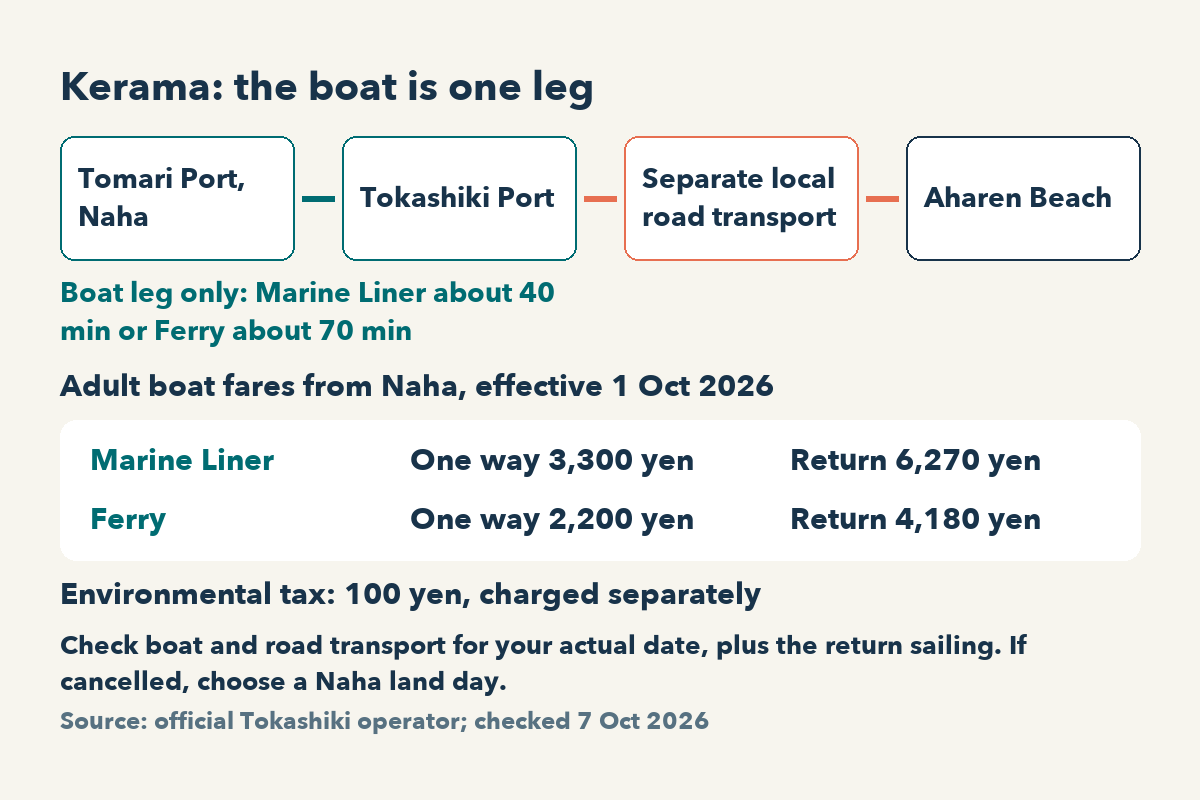
Kerama boats leave from Tomari Port in Naha, not from Naha Airport. No single boat is for day trips and another for overnights. The right boat depends on these factors:
- which island you are going to
- your budget
- the timetable on your date
- how long you want ashore
Sailings can be cancelled in rough seas, so check the operator’s notices on the day.
| Boat | Route | Approx. crossing | Adult one-way | Trade-off |
|---|---|---|---|---|
| Marine Liner Tokashiki (high-speed) | Tomari Port to Tokashiki Port | About 40 min | ¥3,300 (¥6,270 return from Naha) | Faster crossing, higher fare |
| Ferry Tokashiki | Tomari Port to Tokashiki Port | About 70 min | ¥2,200 (¥4,180 return from Naha) | Slower crossing, lower fare |
| Queen Zamami (high-speed; not running 20 Oct to 3 Dec 2026) | Tomari Port to Zamami, some sailings via Aka | About 50 to 70 min | ¥3,950 | Faster crossing, higher fare |
| Ferry Zamami | Tomari Port to Zamami | About 90 to 120 min | ¥2,900 | Slower crossing, lower fare |
The Tokashiki fares are the revised fares effective 1 October 2026. They come from the Tokashiki village fare revision notice and its fare table (PDF), and a separate ¥100 environmental tax applies. The Zamami fares come from the village’s fares and timetable page, which also lists a ¥100 entry tax. Crossing times are approximate. Child fares and seasonal timetables differ, so check the operator pages for your date.
Queen Zamami is out of service from 20 October to 3 December 2026 for dry-dock maintenance, according to Zamami Village’s monthly timetables. On those dates, plan around Ferry Zamami or choose Tokashiki, and check the timetable for your date.
Tokashiki Port is not Aharen Beach. Both the Marine Liner and the ferry arrive at Tokashiki Port. Getting to Aharen Beach is a separate trip by road from the port, so plan it as its own leg. Check what local transport runs on your date and how it lines up with your return sailing.
Booking: the rules depend on the operator and the booking channel. Zamami’s village page says general web reservations open 55 days before sailing and phone reservations open one month before. Check Tokashiki’s village pages for its own rules. An open booking window does not mean seats are available on your date. If your dates are fixed, book as early as the rules allow, and keep a land-day backup either way.
Which months suit a visit, and when can you go whale watching?
The Japan Meteorological Agency’s climate normals for Naha (1991–2020) give a January monthly mean of 17.3°C and a July mean of 29.1°C. Those are monthly means, not daytime highs. They don’t predict how comfortable a given day will feel or whether boats and flights will run.
If relatives can choose their dates, I’d suggest the cooler months for long walking days at castle ruins and in the south, and summer for supervised beach days. Typhoons can disrupt flights and ferries in summer and early autumn, so build slack into trips in those months.
For whales, Visit Okinawa Japan’s January guide notes that whale-watching tours depart from Naha and the Kerama Islands in January. For other months, check the specific operator’s 2026–27 season dates before planning around a whale trip. The same guide notes that beaches differ in winter opening and lifeguard arrangements, so check each beach before planning a swim. Affiliate disclosure: the following is an affiliate link, and I may earn a commission if you book through it, at no extra cost to you. Okinawa whale-watching search on Viator is a catalog, not a guarantee of any particular date. Before booking, confirm the departure point, the date and what happens if no whales are sighted.
Do visiting relatives need their own rental car?
For most visiting-family plans beyond Naha, a rental car makes life much easier. Rail on the main island is limited to the Yui Rail monorail around Naha, and bus trips north are long. Check first that your relatives are comfortable driving on the left.
Licence rules for ordinary US visitors: a US licence alone is not enough. The National Police Agency’s guidance on driving with a foreign licence lists a Geneva Convention International Driving Permit as an accepted route. Two separate time limits apply:
- The permit itself is valid for one year from its issue date.
- The period a visitor may drive in Japan on it ends at whichever comes first: one year after landing in Japan, or the permit’s expiry.
Arrange the permit before departure and carry it with the US licence. This covers ordinary visitors only, not anyone with other status in Japan.
Automatic cars are typical in rental fleets, but confirm when booking. Compare prices, because they vary with season and demand. For the drive north, the Okinawa Expressway runs to Kyoda. For shorter central trips, compare the expressway with Route 58 on a map app at your travel time before paying a toll.
Affiliate disclosure: the following is an affiliate link, and I may earn a commission if you book through it, at no extra cost to you. Okinawa car rental on Klook is one way to compare options. Booking early helps around busy holidays such as Golden Week and Obon.
What’s easy to get wrong here?
- Driving to a shokudo mid-afternoon without checking whether it closes between lunch and dinner.
- Assuming cards work everywhere. Some small restaurants, parking machines and pottery workshops may be cash only.
- Treating Churaumi as a half-day trip from Naha rather than a full day.
- Planning a Kerama day without a land backup.
- Treating arrival at Tokashiki Port as arrival at Aharen Beach.
- Swimming outside a supervised area or season instead of inside the posted swim area.
Frequently asked questions
Is Okinawa worth visiting in January if my family can only come then?
It can be, with adjusted expectations. Under JMA’s 1991–2020 normals, Naha’s January monthly mean is 17.3°C, though individual days vary. Whale-watching tours depart from Naha and the Kerama Islands in January. Beach opening and lifeguard arrangements differ in winter, so check any beach before planning a swim.
Can my parents drive a rental car in Okinawa with their US licence?
Not on the licence alone. Ordinary US visitors can use a Geneva Convention International Driving Permit, which is valid for one year from issue. They may drive on it until one year after landing or until the permit expires, whichever comes first. Driving is on the left.
How far ahead should I book the Kerama boat?
It depends on the operator and the booking channel. For Zamami, general web reservations open 55 days before sailing and phone reservations open one month before. Check Tokashiki’s pages for its rules. An open booking window doesn’t guarantee seats, and sailings can be cancelled, so keep a land-day backup.
Sources checked 7 October 2026 and re-checked 25 October 2026
- Tokashiki Village: boat fare revision notice and fare table (PDF), effective 1 October 2026
- Zamami Village: fares and timetables
- Zamami Village: monthly boat timetables
- Ocean Expo Park: Wednesday partial-opening trial
- Okinawa Churaumi Aquarium: admission information (checked 7 October 2026; on 25 October the site was down for maintenance, and the official web-ticket page it links to showed the same prices)
- Okinawa World: admission fees
- Shurijo Castle Park: main hall opening and admission and park website closure notice
- Japan Meteorological Agency: Naha climate normals, 1991–2020
- Visit Okinawa Japan: Okinawa in January
- National Police Agency: driving in Japan with a foreign licence
- GetYourGuide listing for the Churaumi, Cape Manzamo and American Village day tour (the affiliate link above). Itinerary, audio guide, guide, boarding and meal details were re-checked on 25 October 2026. Price and dates were not.
Prices, timetables and opening details change. Confirm directly with each operator or facility before you travel or drive to the port.
Read next
- Things to do in Okinawa: 30 local picks, organised by area.
- Okinawa 3-day itinerary, for a short window.
- Okinawa itinerary for 7 days, for relatives staying a week or more.
About the author
I’m Daisuke, born and raised in Okinawa (34 years and counting), and I write okinawa-insider.com in English. The plans here are proposals for off-base days with visiting relatives, not guidance on base matters. Confirm prices, timetables and openings with the sources linked above before you go.
Update Log
25 October 2026: Ferry fares, Shurijo opening details and admission, the tour listing and driving-document rules were checked against the linked sources before publication. Prices, schedules and booking availability can change; confirm your date with the operator.